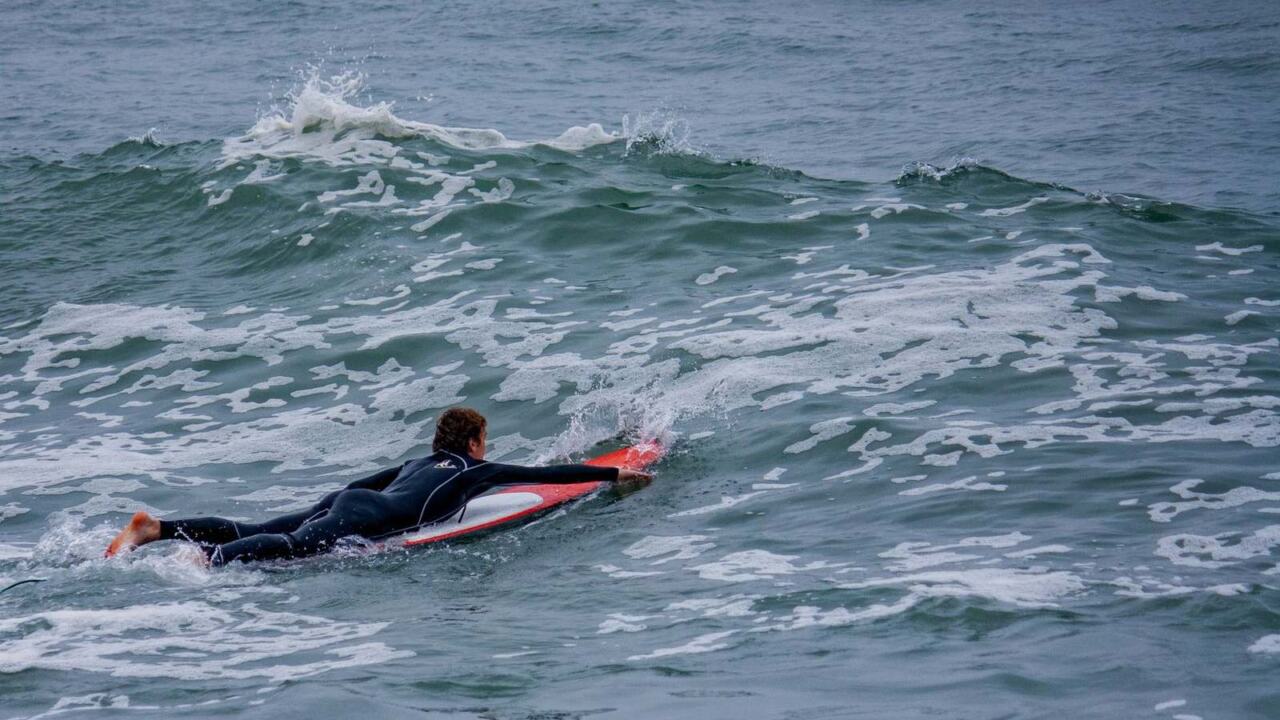
Not sure how to paddle on a surfboard without wearing yourself out? Lie centred, chest slightly lifted, feet together, then pull long, deep, alternating strokes with high elbows.
This page sits within the wider topic of surfing on this site and covers the paddling fundamentals from the water up.
| Item | Value |
|---|---|
| Nose height above the water while lying prone | 2-5 cm |
| Where your hand enters the water in front of your head | 15-20 cm |
| Normal nose lift from the board’s rocker | 1-3 inch |
| Water density compared with air | roughly 800 times denser |
| Suggested technique practice at the start of a session | 10 minutes |
These figures come from a coaching guide on paddle technique and a surf-kids paddling lesson. They can change, so check the sources before you rely on them.
Get your position on the board right
Before your hand touches the water, your prone position decides how well every stroke works. A poor position makes even good arm mechanics ineffective, according to the paddle technique guide.
Start by lying face down with your sternum centred on the stringer and your weight even from left to right. If the board tips to one side, adjust until it sits flat.

Next comes the fore-and-aft position, and the sources frame it a little differently. One coaching guide says to slide until the nose sits 2-5 cm above the surface, as the paddle technique guide explains. Another says to lie as far forward as you can without the nose dipping, which is called pearling, in this paddling guide.
The two ideas fit together once you remember that every board is different. A surf-kids lesson notes that the board’s natural rocker means a 1-3 inch lift is normal, but more than that means you are too far back, as the surf-kids paddling lesson puts it.
A simple way to find your spot:
- Paddle in flat water and watch the nose.
- If the nose sinks, scoot back until it hovers above the surface.
- If the nose lifts hard and the tail seems anchored, move forward until the board sits evenly again.
- Mark where your chest lies with a sticker or paint so you can find the spot again.
Two more details matter. Lift your chest with a gentle arch of the lower back, like a mild cobra pose, and keep your feet together with the toes just off the tail. Dangling legs act like sea anchors, creating drag and shifting your centre of gravity, per the paddle technique guide.
What does an efficient paddle stroke look like?
The surf stroke borrows a lot from freestyle swimming, but you are lying on a board and cannot rotate your torso as freely. Think of it in four phases: entry, catch, pull and exit.
The entry
Reach forward with one arm fully extended. Your hand should enter the water roughly 15-20 cm in front of your head, with fingers together and slightly cupped, as the paddle technique guide describes.
Let your fingertips break the surface first. This reduces splashing and saves energy, according to the paddling guide.
The catch and the pull
Treat your forearm as a paddle blade and press as much of it against the water as you can. The most efficient paddlers get the forearm vertical early in the stroke, bending the elbow so the forearm points down instead of sweeping water with a straight arm.
Then pull straight back along the rail, close to the board’s edge. Keep your elbows high throughout, which the paddling guide says helps you catch more water and engage the larger muscles of the lower back instead of straining the shoulders.
The exit and recovery
When your arm reaches full extension behind you, release it cleanly from the water. Do not pull past your natural range, because that wastes energy and breaks your rhythm.
On the way forward, keep the elbow high. A low, lazy recovery drags the hand and slaps the surface instead of setting up a clean catch.
Timing, rhythm and breathing
Alternate your arms in a smooth, steady cadence. The power should come from your lats and core, not just your shoulders.
Long, deep strokes beat short, rapid ones, which waste energy and create turbulence. Water is roughly 800 times denser than air, so every bent elbow or splayed hand creates drag, as the paddle technique guide points out.
Breathing is part of the stroke too:
- Take slow, deep breaths instead of shallow, rapid ones.
- Inhale during a long glide or smooth stroke, and exhale fully before the next one.
- Before a hard effort such as a wave, take a few controlled breaths to prepare.
- Stay calm in tough conditions, because panic shortens your breathing.
All of this comes from the paddling guide. The same source suggests saving your hardest effort for catching waves, paddling against currents and paddling back out. When the current moves in your direction, slow, controlled strokes will do.
Common paddling mistakes to fix
Most paddling problems come down to a handful of habits. Here are the ones the paddling guide lists, with the fix for each:
- Too far back: the nose lifts and drags. Move forward until the board lies flat with the nose just above the surface.
- Dangling feet: they create resistance and unsettle the board. Keep your legs together and your feet slightly off the tail.
- Over-reaching: it leads to inefficient strokes and shoulder strain. Aim for smooth strokes with proper hand entry and elbow alignment.
- Short, rapid strokes: they waste energy. Go longer and deeper.
- Ignoring your core: you become unstable. Keep your body balanced and let the core stabilise you.
- Not watching the sets: you get caught off guard. Keep an eye on incoming waves and adjust your pace.
Poor positioning also has a physical cost. If your body is in the wrong place or you move badly, you rub your chest and belly harder against the board and press on your ribs, which can lead to surf rash, according to the surf-kids paddling lesson.
Drills and practice habits
Practise somewhere calm before you take your technique to the lineup. That could be the ocean on a flat day, a lake or even a pool, as the surf-kids paddling lesson suggests.
Then make it a habit. The paddle technique guide says 10 minutes of deliberate practice at the start of each session will transform your surfing within weeks.
Here is a simple routine to use in those minutes:
- Check your prone position: centred, chest lifted, feet together.
- Paddle with only the fingertip-first entry, watching for splash.
- Focus on getting the forearm vertical early.
- Count a slow breathing rhythm across several strokes.
- Finish with a few long, relaxed strokes while you check the nose height.
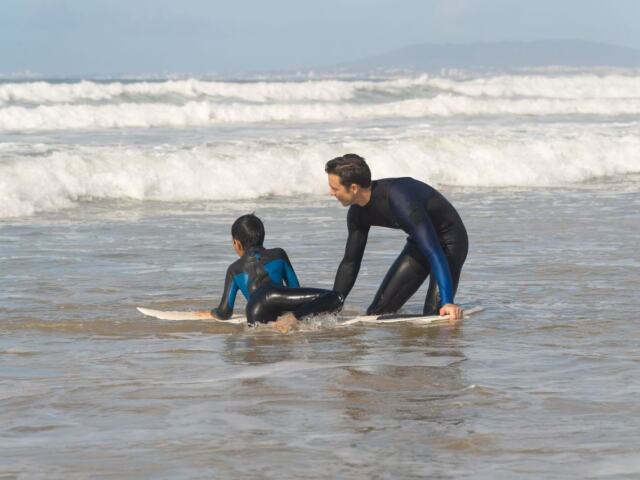
If you are teaching a child, adjust your expectations. Kids have small arms and bodies, so they may need a different sweet spot and a properly sized board, as the surf-kids paddling lesson cautions.
From paddling to catching waves
Good paddling and good wave catching share the same foundation: correct body position. When you paddle well, you are less likely to nosedive from sitting too far forward or miss the wave from sitting too far back.
The paddling guide adds that most pearling happens because the surfer was not paddling fast enough, or shifted their weight forward at the wrong time. Paddling the board also raises the nose out of the water.
Once you are moving with the wave, the next skill is the stand-up. You can read about how to pop up on a surfboard to turn that paddle into a ride. Which foot you lead with is a separate question, covered in the explainer on regular or goofy stance.
Frequently asked questions
Where should I lie on the surfboard to paddle?
Show answer
Lie with your sternum centred on the stringer and your weight even from side to side. Then slide forward or back until the nose sits just above the water without pearling. Every board has a different sweet spot, so test it in flat water.
Why does my board nosedive when I paddle?
Show answer
Usually you are too far forward, or you are not paddling fast enough, or you shifted your weight forward at the wrong time. Scoot back a little, keep your chest lifted and keep paddling. Paddling the board raises the nose.
How do I avoid surf rash while paddling?
Show answer
Surf rash comes from rubbing your chest and belly against the board when your position or movement is wrong. Find your sweet spot, lift your chest gently and use a smooth, efficient stroke so you are not grinding on the deck.
How long should I practise paddle technique?
Show answer
One coaching guide recommends 10 minutes of deliberate practice at the start of each session, as described in its paddle technique lesson. Start in flat water if you can.