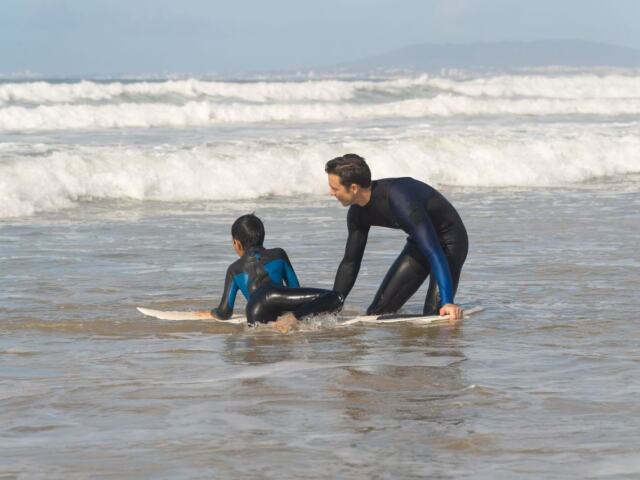

Not sure whether you ride a regular or goofy stance? You’ll find out in minutes: whichever foot feels natural in front is your answer, and neither is better. A few simple land tests will confirm it before you paddle out.
This guide sits within the wider world of surfing, and stance is one of the first things to settle.
| Item | Value |
|---|---|
| Regular stance | Left foot forward, right foot back |
| Goofy stance | Right foot forward, left foot back |
| Share of surfers who ride goofy | 30-40% |
| Stance width | Roughly shoulder-width |
| Foot angle | 15-30° across the stringer |
| Weight over the back foot | 60% |
The figures come from a surfing stance guide and a surf-camp coaching lesson. They can change, so check the source before you rely on them.
What regular and goofy actually mean
Your stance is simply which foot sits at the front of the board when you stand up. The two options are easy to remember:
- Regular: left foot forward, right foot back.
- Goofy: right foot forward, left foot back.
- Power foot: the back foot, which drives turns and controls speed.
The name “goofy” has nothing to do with skill, and there is no wrong answer. One stance guide points out that Kelly Slater is a world champion regular footer and Tom Curren is a world champion goofy footer.
Regular is the more common choice, which is how it got its name. Some studies have shown that only 30-40% of surfers are goofy-footers, so if you land in that group you are in plenty of good company.
Stance is not a style choice you make from a poster. A coaching lesson describes it as linked to your neurological dominance, similar to being left- or right-handed, so the goal is to uncover your preference rather than pick one.
How to find your stance with simple tests
Most beginners already have a natural preference and just need a way to bring it out. One coaching lesson lists five tests and suggests you try them all, then go with the foot position that comes up most often.
Here are four that need nothing but a floor, a friend and a board:
- Push test. Stand with your feet together and eyes closed while a friend gives you a gentle but firm push from behind. Whichever foot shoots forward to catch you is your front foot.
- Slide test. Put on socks, find a smooth tile or hardwood floor, take a running start and slide. The foot that naturally leads is your front foot.
- Kick test. Kick a ball. If you kick with your right foot you are likely regular, and if you kick with your left you are likely goofy.
- Board test. Hop on a surfboard or skateboard without thinking and see which foot goes to the front.
If you try the board test on a surfboard on hard ground, remove your fins first. Otherwise you can damage the fins and possibly the board.
The kick test works differently from the others, because your kicking foot tends to be your back foot on the board. That is why a right-footed kicker is likely to be regular, with the left foot forward.

If you only have time for two tests, the same lesson says the push test and slide test are the most reliable indicators. Repeat whichever one you choose a few times, because a single push can mislead you.
What if the tests disagree?
Some people genuinely feel comfortable both ways. In that case, the coaching lesson advises that you pick one and commit for at least five sessions before switching.
Committing matters because balance, turns and wave control all build on a consistent foot position. Swapping every session means you restart that learning each time.
If you already skateboard or snowboard, you may have your answer. One guide says your stance will rarely change between board sports, so a stance you know from those carries across.
A small percentage of surfers are truly ambidextrous and can ride switch stance, meaning the opposite foot forward. The same lesson calls that an advanced skill, so leave it for later.
How your stance shapes the waves you ride
Stance decides which way you face the wave, and that is where the words frontside and backside come in. One guide defines frontside as chest and toes facing the wave, and backside as back and heels facing the wave.
- A regular footer rides frontside on waves breaking to their right and backside on waves breaking to their left.
- A goofy footer rides frontside on waves breaking to their left and backside on waves breaking to their right.
Surfers generally favour frontside because it feels more natural going down the line, so backside is harder at first. The same guide notes that regular surfers tend to love right-hand point breaks and goofy surfers tend to love left-hand point breaks.
That does not mean you should avoid your backside direction. Once you advance, you may stop favouring one over the other.
Knowing which way a wave breaks relative to your stance also helps you choose where to sit, and it pays to read up on surfing etiquette before you paddle out and pick a peak.
Setting up your stance on the board
Once you know your front foot, the setup is about balance. The coaching lesson gives roughly shoulder-width for stance width, feet angled 15-30° across the stringer, and 60% of your weight over your back foot.
Run through this checklist as you stand up:
- Land your feet over the stringer and toward the back of the board.
- Bend your knees and stay low.
- Keep your head and shoulders facing your direction of travel.
- Shift forward only when you want speed.
Knees that point out too far give you the infamous poo stance. One guide says the name comes from looking as if you are sitting on a toilet, and that coaches frown on it, so keep your knees in line with your shoulders or pointed in slightly.
Foot placement along the board matters too. If you pop up too far forward, with your front foot too close to the nose, you will struggle to shift your weight back enough to avoid pearling, which is nosediving.
Later on, your feet will not stay fixed. Moving toward the front of the board is generally the easiest way to create speed, while staying toward the back is the easiest way to dig into a turn.
None of this works if you cannot get into position, so practise how to paddle on a surfboard alongside your pop-up.
Frequently asked questions
Is a regular or goofy stance better?
Show answer
Neither. One guide says regular footed surfers are no better at surfing than their goofy counterparts, and vice-versa. Another says the better surfer is defined by talent and training commitment.
Can I change my stance if I start in the wrong one?
Show answer
You can, but give your first choice a fair trial. A coaching lesson advises committing for at least five sessions before switching, and calls riding the opposite way, known as switch stance, an advanced skill.
Does my stance affect which surfboard I buy?
Show answer
No. One guide states that your surfing stance will not have any effect on the surfboard you choose or your surf equipment, although it does affect how you ride the waves.
Will my skateboard stance match my surf stance?
Show answer
Usually. One guide says your stance will rarely change between board sports, so a skateboarder or snowboarder often already knows the answer.