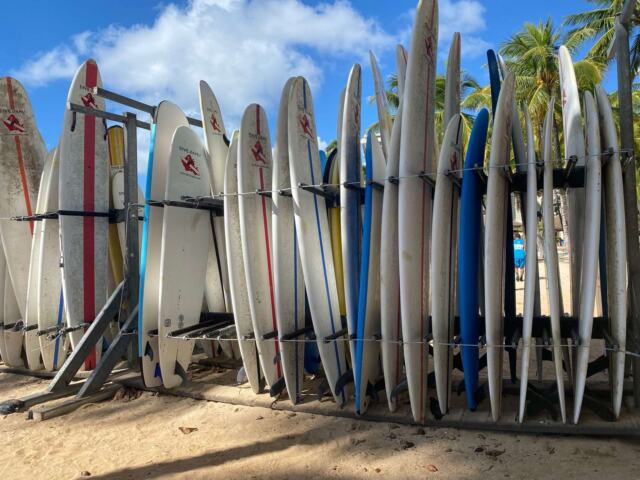
Staring at a wall of boards, you may wonder how to choose a surfboard. Pick a long, wide, high-volume soft-top of at least 7’6″ and save the shortboard for later.
This guide sits within the wider world of surfing on this site, and it focuses on your very first board.
| Item | Beginner guideline |
|---|---|
| Minimum board length | 7’6″ (roughly 228 cm) |
| Sweet-spot length for most adults | 8’0″ to 9’0″ |
| Minimum board width | 21 to 23 inches (53 to 58 cm) |
| Minimum volume rule | Body weight in kg × 0.8 to 1.0 = litres |
| Typical 8’0″ soft-top volume | 70 to 90 litres |
| Advanced shortboard volume | 25 to 30 litres |
These figures come from a surf-camp beginner guide. They can change and other guides differ, so check the source before you rely on them.
Why your first board matters so much
Every beginner skill, from paddling to standing up, is shaped by the board under your feet. According to the surf-camp guide, a board with enough volume floats you high, paddles efficiently and gives you a stable platform to stand on. A board without it sits low in the water and tips at the slightest shift of weight.
The goal is simple: catch more waves with less effort. A surf shop’s sizing guide says beginners should choose a larger board with more volume, generous length and extra width and thickness.
Be honest about your level, too. One paddle-board retailer’s guide says that if you haven’t been surfing for over a year, even two years, you are still a beginner. Buy for the surfer you are now, not the one you hope to be.
The three numbers: length, width and volume
The surf-camp guide names three key specifications: length, width and volume. It calls volume the single most important number when selecting a surfboard, so give it the most weight.
Length
Longer boards are more stable, paddle faster and catch waves earlier. The same guide sets a minimum of 7’6″ (roughly 228 cm) for beginners, with 8’0″ to 9’0″ the sweet spot for most adults.
Your body weight moves that range up or down:
- Under 70 kg: 7’6″ to 8’0″ is usually sufficient.
- 70 to 90 kg: 8’0″ to 8’6″ gives better float and stability.
- Over 90 kg: 8’6″ to 9’6″ (or a dedicated longboard) ensures adequate buoyancy.
Do not assume a long board is a slow one. It turns differently, using rail engagement rather than tail pivots, and those mechanics carry over to shorter boards later. As a quick check, the ISLE guide suggests a beginner board should be at least a foot longer than you are tall.
Width
Wider boards are more stable from rail to rail. The surf-camp guide says a beginner board should be at least 21 to 23 inches (53 to 58 cm) wide, while a high-performance shortboard might be 18 to 19 inches wide.
Standing on something that narrow takes balance skills that need months or years to develop. A wide, flat platform is what lets you learn the pop up without constant falls. Once your board is sorted, read up on how to pop up on a surfboard to make the most of that stability.
Volume
Volume is measured in litres and tells you how much buoyancy the board gives you. The surf-camp guide offers a rough rule: multiply your body weight in kg by 0.8 to 1.0 to get a minimum volume in litres.
- A 75 kg surfer should look for 60 to 75 litres minimum.
- A 90 kg surfer should aim for 72 to 90 litres.
These numbers look huge next to the 25 to 30 litre shortboards that advanced surfers ride. That is the point: beginners need extra volume to make up for paddling power and wave-reading skills they have not built yet. The guide’s key takeaways give a wider range of 60 to 100+ litres depending on body weight.
Not every guide agrees. The ISLE guide says beginners should ride a board that exceeds 40L, and adds that if you weigh more than 200 pounds you should pay close attention to buoyancy. When figures differ, the more generous one is the safer choice.
Why a soft-top is the usual first board
The surf-camp guide says the overwhelming recommendation from surf coaches worldwide is to start on a soft-top foam board. These boards have a layer of closed-cell foam on the deck and often a soft, rounded bottom, plus flexible rubber fins instead of hard fibreglass ones.
The same guide gives several reasons they suit beginners:
- Safety: the soft deck and rounded rails reduce the risk of injury from board contact, to you and to other surfers.
- Durability: soft-tops resist dings, cracks and pressure dents that would damage a traditional board.
- Volume: an 8’0″ soft-top typically has 70 to 90 litres, which is the range beginners need.
The ISLE guide adds that funboards and longboards are also good options because they are big, thick and wide. If you want to compare shapes, the guide to types of surfboards covers them in more detail.
Skip the performance shortboard
The ISLE guide is blunt: do not get a performance shortboard as a beginner. It says you will not get better on one because it is too small, thin and narrow to comprehend how to surf it. The surf-camp guide agrees, noting that small boards require advanced skills beginners have not developed yet.
Tail shape and fins
You can ignore most of the fine print at this stage. The ISLE guide says tail shape and the number of fins do not matter for a beginner, and that thrusters, quads and single fins are all fine setups. Spend your attention on size, volume and condition instead.
Should you rent, borrow or buy?
The surf-camp guide’s advice is to rent or borrow before you buy, so you can experience different sizes and find the right fit for your body and ability. A few sessions on different boards teach you more than any chart.
- Rent or borrow a soft-top in the size range that suits your weight.
- Notice how easily you paddle, catch waves and balance on each board.
- Call your local surf shop to ask which affordable beginner boards it has.
- Buy once you know which size feels right.
Used boards can save money. The ISLE guide says you can ignore minor flaws such as yellowing on the deck and small dings, because they can be fixed. It tells you to avoid any used board with damage that shows foam or delamination, where the fibreglass is separating from the foam core.
The same guide also warns against spending upward of $1,000 on a custom longboard as a first board. It recommends a new soft board that is durable and harder to ding, or a quality used one.
Mistakes to avoid when buying your first board
The surf-camp guide lists four common board-buying mistakes. Each one comes down to choosing a board for your ambitions instead of your current skills.
- Buying too small: a small board demands paddling and balance skills you have not built yet.
- Buying for the surfer you want to be: the guide says coaches gently suggest students set aside aspirational shortboards until their fundamentals are solid.
- Ignoring volume: length alone does not tell you how much a board will float you.
- Skipping the soft-top phase: foam boards are the safest, most forgiving place to learn.
Before you pay, run a quick checklist:
- Is it at least 7’6″ long?
- Is it at least 21 inches wide?
- Does the volume meet your weight-based minimum?
- Is it a soft-top or another big, thick, wide board?
- Is it free of damage that shows foam?
Frequently asked questions
What size surfboard should a beginner get?
Show answer
The surf-camp guide recommends a minimum of 7’6″, with 8’0″ to 9’0″ the sweet spot for most adults. Heavier surfers should go longer.
How much volume do I need?
Show answer
Multiply your body weight in kg by 0.8 to 1.0 for a minimum in litres, so a 75 kg surfer needs 60 to 75 litres, according to the same guide. Another guide sets a lower floor of 40L, so lean toward the higher figure.
Should my first board be a shortboard?
Show answer
No. Both the surf-camp guide and the ISLE guide say beginners should avoid performance shortboards because small boards need skills you have not developed yet.
Is a second-hand board a good idea?
Show answer
It can be, if the price is right and the board is sound. The ISLE guide says to avoid used boards with damage that shows foam or delamination.
How long am I a beginner?
Show answer
Longer than most people expect. The ISLE guide says that if you haven’t been surfing for over a year, even two years, you are still a beginner.